.png)


Near Death – Snowy Hampta Pass Trekking Expedition, Himachal Pradesh.
- Sampada Kalamkar
- Sep 25, 2021
- 9 min read
Updated: Nov 25, 2021
“It feels good to be lost in the right direction”
Experience shared by Sampada Kalamkar, an avid traveler; a software enthusiast converted to full time art and music entrepreneur.
Creator of ArtssyZen https://www.instagram.com/artssyzen/ 
Sampada Kalamkar https://www.instagram.com/sampada_kalamkar/
Hampta Pass is the most delightful trek in Manali, Himachal Pradesh. It is a moderate trek with scope for varying the duration to suit one’s time. It takes us over the majestic foothills of the Himalayas, The Pir Panjal range. It’s a beautiful trek from Jobri in Kullu Valley to Chatru in Lahaul Spiti Valley. In the short duration of 5 da
ys, you see the landscape changes from lush green to the barren landscape of Spiti Valley & a visit to Chandratal Lake is icing on the cake.

Being an avid traveler and in love with mountains, I’m always fascinated to trek anywhere in the Himalayas. I used to trek around Pune with my friends, and it wasn’t my first time in the Himalayas, but it was my first solo trek. Initially, I had booked for Roopkund Trek (Uttarakhand). As trek was canceled around two weeks before it would start because the Uttarakhand high court had banned night stays and the limited number of tourists visiting the meadows. So Roopkund trekkers were offered an option of Hampta Pass along with Chandratal Lake on the exact dates and duration. I wasn’t aware of this route at all. So, I decided to take some risks and confirmed my presence with a diverse group of unknown travelers.

Hampta Pass connects two beautiful valleys, Kullu and Lahaul. It gives breathtaking views of the Himalayas, glacial valleys, thick pine forest, open meadow, and adventurous crossing of a river and high-altitude pass. This trek is considered the easiest and convenient of all treks in Himachal. This trek route falls under easy level with five camps- Sethan, Chikka, Balu ka Ghera, Siagoru, and Chattru, Chandratal Lake. Hampta Pass Summit (14,025 feet) is located in between Balu ka Ghera and Siagoru.

Note : I tried my best to explain it, but it’s tough to express the exact situation we all experienced.
So, about two years ago,
My expedition towards Hampta Pass started from Delhi. I had an overnight bus journey to Kullu, Himachal Pradesh, as my reporting date was 17th Sep 2018 at YHAI Base Camp Kullu. One day additional acclimatization near Beas River with beautiful Koli dance performance at night around the campfire was overwhelming. The next day a group of 13 trekkers along with two guides started our most awaited trek. Most of us were new to the place, and adding up an adventurous plan was, off-course, a considerable challenge as well as joy.

Prini to Sethan (Camp 1)
Starting from Prini, the trek was around 5-6kms. On our way, we crossed a place called Panduvrupa, where Pandavas used to bathe. From the beginning of the trail itself, we could see big mountains made of vertical rocks. The view around us was stunning.

Sethan to Chikka (Camp 2)
The following day, we started our journey towards Chikka. The trail was clear at most of the places and made of rocks of different sizes. The valley itself changed size from beginning narrow and wide in places. We crossed over a wooden bridge soon reached the Chikka campsite. The site was a refreshing, vast, and spacious patch of greenery. The weather was perfect, the views were breathtaking, and the path had not ascended. Waterfall near Chikka, where our guide took us to get some peace and relaxation.

Chikka to Balu ka Ghera (Camp 3)
On our 3rd day, we wake up with the chirping of birds. We had a delicious breakfast and continued towards Balu ka Ghera camp. We had to cross a river, which did not have a bridge. The only way to cross was by removing our shoes and hiking up our pants till our knees. We crossed it barefoot, and the water was icy cold. The river was crystal clear. Water comes up to a little above the knees and flows with a lot of force. It is best to cross the river before 2 PM, as the flow of the water increases as the day passes due to the melting of snow. There were a couple of streams for us to cross. It wasn’t very difficult for us. But, this river crossing Uffff! The river bed is full of rocks- big and small rocks, sharp and flat, and it is impossible to see where we will keep our next step. The day was thrilling for me as the trek involved all this adventure. We reached the campsite well in time. Some folks say the name Balu here stands for Bears, as bears live around this area!

From here, we looked back, and we could see an eye-warming view of the beautiful Hampta Pass valley below- Speechless! The brilliantly majestic mountains, with their brown and black stone walls. It was raining this evening. The first three days were fine from a climate point of view, and we completed our trek successfully till Balu Ka Ghera (11898ft). We were a little apprehensive about the weather, especially since the night it had rained – all night. Moreover, this day was supposed to be the most challenging part of the trek because we would cross Hampta Pass. We all had been carrying our backpacks for the whole trek. The day’s trek encompasses around 8 hours, and the distance covered will be around 14kms. If it was raining, our trek was going to be more complicated and riskier.

Balu Ka Ghera to Siagoru (Camp 4)
We left Camp early morning with overloaded excitement as we were going to cross Hampta Pass Summit on this day. The route was going to be more complicated than the earlier all camps. My mood at the time of breakfast was a mix of excitement and nervousness. At around 8 AM, after a delicious breakfast, we finally started our trek. The first part of the trek was surprisingly easy. The trail was beautiful and was through a little flowery meadow. It was already raining when we left the Camp, but we assumed that the climate would be evident when we reached the next Camp. As soon as we proceeded closer towards Hampta Pass, the route got steeper, so much rocky, slippery, and difficult to walk.

We faced heavy rain and snowfall soon. Unfortunately, the climate condition got more worsened as we proceeded towards Summit-14100ft. Initially, every individual was so excited when we had experienced snowfall. We were not expecting snowfall in this trek as September is not ideal for snowfall in Hampta Pass. I continued to walk. Everyone went ahead so fast. A boy and I were walking in the last. It was very foggy there. So, we are supposed to move forward as early as possible. Just when we were about to approach Hampta Pass, we saw a girl falling from the snow towards the valley, one guide was pulling her up, but the surface was slippery. We rushed towards her and started pulling her up. Finally, she came up and started crying. We continued to walk again by holding her hand one by one. I was so scared while moving ahead.

Now I realized very late that this was not going to be easy. We crossed Hampta Pass in such a heavy snowfall and started descending. Guide told us, “Weather condition is not good. Do not take any rest and keep walking. We have to reach the next Camp ASAP.” We kept on walking through snow continuously to reach Sheagoru camp as early as possible. I was facing difficulty proceeding ahead due to invisibility and the rocky path. It was a slippery route, and many group members rolled down when they fell on the snow. As a professional, I was singing Bollywood songs loudly to distract myself and other members from the pain and motivate them.

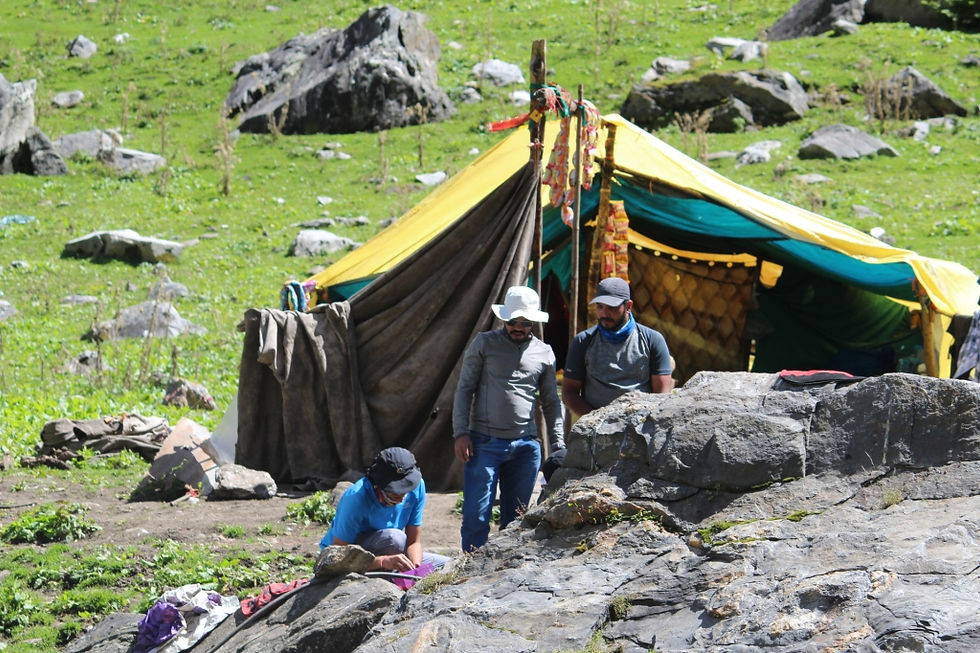
Finally, we reached the Camp in the evening in fatigued condition and had some minor injuries. That night weather conditions got worse than the whole day. Snowfall dropped the temperature below -5 °C or -10 °C approximately. There were only three girls (including me) in our group who had to move to the guide’s tent in the night because heavy snowfall collapsed our tent due to the unbearable weight of snow. The whole night each and everyone was busy clearing snow on the tent. The following day, we were shocked by seeing that nearly all tents collapsed and the snow level increased by 3 feet almost.

Sheagoru to Chattru (Camp 5)
The following day, the weather condition did not clear at all. Himalaya gave us an additional bonus of fast wind, falling glaciers with heavy snowfall continuously. We discussed going back to the previous Camp but realized that it was almost impossible to go back as the route was invisible and any accidents occurred while ascending. As we did not have any option to go back or stay at Sheagoru camp, we decided to take the risk, go further towards the last Camp, i.e., Chattru (located at Gramphu-Batal-Kaza road near Chenab River) and hoped to have a better climate soon.

The next day was the big day because it was supposed to be the most challenging day of our trek. I had completed all the previous camps very slow as compare to other members. This day I had to walk fast to be with the group. We didn’t get any packed lunch or hot water for the day except one cup of cornflakes each. In between, I collected full of snow in a water bottle, kept in the skin-tight pocket (body heat works in this situation). In that critical situation, around 7.30 AM, we started walking to reach our final destination, Chattru camp. Without breakfast/lunch, we had to walk for the next 12-13 hours, too, with constant windy snowfall. Finding the trail and clearing the snow was one of the most difficult challenges I was facing. Everyone was shivering, dehydrated. Some of them were suffering from high altitude sickness symptoms like vomiting, headache, etc.
It was around 3.30 PM, and we covered only half the route. Total three guides from another group, including the kitchen staff and our group, led the complete trail. They were so fast, which was creating a massive distance between us. Some trekkers, including me, were following, trying to catch them with the help of footprints on the snow. The remaining, including our guides, were walking a little behind us. Everyone was tired, hungry, and expressing a strong desire to reach as soon as possible. It was around 6.30 PM and dark. Trail (Footprints of leading persons) was not visible at all without a torch. A girl could not even walk due to a health problem, and a porter had to lift her, one boy’s shoes were broken, another lost his shoes in the water stream across the snow, and both had to walk to the Camp without shoes. I was not aware of this incident as I was walking ahead of these people. At one point, I felt that nobody was walking behind me. I turned back, and I realized that I was alone. I waited for some time and tried to call them but no reply. I could not stop at one place because standing in the snow with wet shoes and clothes was the most’ about to die’ situation I ever felt. As I had no option to go back and search for them, I decided to walk further by searching for Footprints on snow. Also, I lost my torchlight while crossing another water stream, and it was around 7.15 PM. I was blank and scared, having thought of reaching Camp alone without a torch.

At one point, I was so tired, shivering, thirsty, too much exhausted because of an empty stomach, and started feeling dizzy. I got a feeling of losing control of my mind and body balance, no sensation in my legs. I wasn’t sure whether the route was correct or not, will find a camp or not. I didn’t know if I was going to live or not, and I started crying. While dead walking, I noticed one shining light of hope on another side of the river. One of the miracle moments ever in my life. Then I started to keep motivating myself by saying, “This is not the end. I have to complete this trek. Go! Go! Go Girl! you can do it, keep walking!” I misunderstood that light means ‘YHAI camp’ where a person was supposed to be present because he was leading. But I was wrong; that light was a local place that provides food and temporary shelter. When I reached that place, no one was there.

Then I heard that dogs were barking. I felt that someone would help me out there. I decided to go further, and again I started walking towards the voice. A chilled water stream was flowing below the snow; I crossed the bridge at Chattru and finally reached the ‘Dhaba,’ around 400m ahead of the campsite. I did not remember the activities at ‘Dhaba’ as I was unconscious after reaching there. Dhaba lady and other people helped me a lot to get out of this trouble. They provided me medicines, food, and shelter too.

The following day, I heard that all my trek-mates completed the trek and were safe. They spent the whole night in the YHAI camp without enough blankets and sleeping bags. They came to the dhaba in the morning, and we moved to a private rest house located at Chattru. Another group was also there to welcome us, and we were so happy to see all. This was the place where all-around 50 people got shelter for the next few days. We slept in such a crowd you can’t imagine.

On 25th Sep 2018, the weather got normal. But still, we were in the resthouse for the next 5-6 days as there was snow on roads and no network connectivity. But the thing was that we were all together united, helping each other. On 29th Sep 2018, in the evening, two Indian Air Force choppers arrived at the place. This may be a collective effect of YHAI, our family members, and our friend’s efforts towards our rescue. 4 trekker girls (including me) were rescued and taken to the SASE Helipad, Manali. After first aid and check-up, one trekker was taken to Civil Hospital, Manali, and the rest of us were suggested by Air-force officer to stay in the Government Circuit House, Manali, for the night. The remaining all trekkers were rescued on next morning, and they disembarked at Kullu Helipad. We traveled back to basecamp and started our journey towards Home.


Comments